What Is an Immersive Art Exhibition?
The immersive art exhibition is intended for a theatre experience, where the viewer is not the viewer, but the part being observed from a distance. Floors, ceilings, and at times walls become projected areas. Soundscapes, lighting, and sometimes tactile elements work together to generate a multisensory environment. Instead of merely showing artwork, the goal is to envelop visitors in an enveloping atmosphere that responds to their movements and existence.
Each exhibit is unlike the usual exhibition showcases in the galleries, its stress on the experience over the object. In this instance, digital projections reconstruct famous paintings of old, historical themes, or abstract ideas in monumental proportions that the audiences can walk through presented landscapes, stand under animated brushstrokes, or interact with motion-sensitive installations. Such exhibitions commonly involve a convergence of technology, design, and storytelling, calling out to the question, "How can art change while always reaching back to the roots of art history?"
Understanding Digital Art Experiences
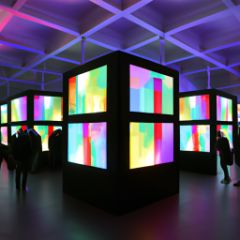
Digital art experiences rely on technology as both medium and message. Artists use software, coding, projection mapping, virtual reality, augmented reality, and generative systems to create works that change in real time. In these spaces, the artwork may react to audience movement, sound, or environmental data.
This form of art expands creative boundaries. It allows for dynamic imagery, layered narratives, and large-scale transformation of physical spaces. While some digital art experiences reinterpret classic painters, others are entirely contemporary, focusing on abstract visuals, artificial intelligence, or interactive storytelling. The emphasis is often on participation, encouraging viewers to move, explore, and sometimes shape the outcome of what they see.
Why Immersive Art Has Gained Popularity in Canada
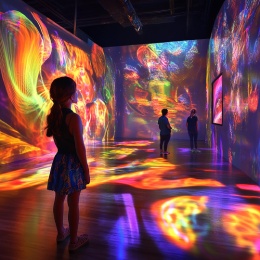
Big cities in Canada now see cultural shows as a front of cultural experiences that combine both entertainment and education as provided to the tourists. Enormous city venues fully cater to projection shows due to their size; with the art lovers being open to new interactive forms, to say the least. All these places require family fun, visitors who have turned young or came on vacation elsewhere, walked into art galleries further away away from the paint-covered walls.
In broadest sense, such leanings are seen in the ways people today do recreational things, culture perhaps included. An interest in social sharing and experiential travel informs that, lead on by interactive design, expectations have undergone transformations. People welcome very much the feeling of standing in something personal and loaded with eye candy. Interpretative materials sometimes are included for the offer: a case or two of exhibitionism placed into context. Striking a balance between visual indulgence and real substance fortifies the march of the ephemeral from the sains and boards of their presentation.
Top Immersive Art Experiences in Canada
Canada hosts several prominent immersive exhibitions and digital art venues. While formats vary, each offers a distinct approach to technology, storytelling, and artistic interpretation.
Immersive Van Gogh Exhibits Across Canada
Immersive adaptations of the work of Vincent van Gogh have toured multiple Canadian cities, including Toronto, Vancouver, and Montreal. These exhibitions project animated versions of his paintings onto massive walls and floors, accompanied by music and narrative elements. Visitors move freely through the space as brushstrokes swirl and landscapes shift around them.
The format allows audiences to experience familiar works, such as Starry Night or Sunflowers, in expanded form. Rather than viewing a single canvas, guests are surrounded by magnified details and layered animations. While interpretations differ by producer, these exhibitions typically aim to introduce broader audiences to Van Gogh’s life and artistic development through an accessible visual spectacle.
Arsenal Contemporary Art in Montreal and Toronto
Arsenal Contemporary Art operates large-scale art spaces in Montreal and Toronto. Although not exclusively digital, these venues frequently host immersive and installation-based exhibitions that transform entire galleries. Artists use projection, sculpture, and spatial design to create environments visitors walk through rather than simply observe.
The scale of Arsenal’s industrial-style buildings allows for ambitious projects. Exhibitions often combine contemporary art with technological components, encouraging reflection on space, architecture, and perception. By presenting both immersive works and traditional contemporary pieces, these spaces bridge the gap between conventional gallery settings and experience-driven exhibitions.
OASIS Immersion in Montreal
Located in downtown Montreal, OASIS Immersion is one of Canada’s largest permanent immersive art spaces. The venue features multiple galleries equipped with high-resolution projections, spatial audio systems, and interactive zones. Exhibitions range from nature-themed journeys to abstract digital creations and historical explorations.
The venue emphasizes accessibility and education alongside visual impact. Visitors often encounter informational panels and curated narratives that explain the themes behind each show. The combination of technology and structured storytelling positions the space as both cultural attraction and interpretive environment.
Traveling Digital Exhibitions
Touring projection-based exhibitions have visited several Canadian cities, bringing immersive art experiences to temporary venues. These shows reinterpret classic works using animation and music to create emotional resonance.
Often staged in convention centers or repurposed industrial spaces, traveling exhibitions make immersive art accessible beyond traditional museum districts. Their mobility has helped expand the reach of digital art experiences to regional audiences, allowing more communities to engage with large-scale visual storytelling.
How Immersive Exhibitions Differ from Traditional Museums
Traditional museums focus on preserving original works, presenting them with careful lighting and contextual interpretation. Immersive exhibitions, by contrast, frequently reproduce or reinterpret artworks digitally. This distinction raises important considerations about authenticity and artistic intention.
However, immersive spaces serve a different purpose. They aim to spark curiosity and emotional engagement, often acting as gateways to deeper exploration. For some visitors, a digital exhibition may inspire subsequent visits to museums housing original works. For others, the immersive environment itself is the primary attraction. Both formats coexist within Canada’s broader cultural ecosystem.
Technology Behind the Experience
Immersive exhibitions rely on advanced technical infrastructure. Projection mapping allows images to align precisely with walls and architectural features. High-powered projectors ensure clarity across large surfaces, while synchronized sound systems create enveloping audio environments. Motion sensors and interactive software enable installations to respond to visitor movement.
Behind the scenes, teams of designers, programmers, and technicians collaborate with curators and artists. Digital files must be optimized for scale, and systems require constant calibration. Although visitors see seamless imagery, the underlying systems are complex. Understanding this technical dimension highlights how immersive art represents a convergence of creativity and engineering.
Educational and Cultural Impact
Immersive exhibitions often incorporate educational components. Timelines, voiceovers, and thematic sections provide historical or artistic context. Schools and community groups frequently attend these exhibitions as part of cultural programming, finding that large-scale visuals can make art history more engaging for younger audiences.
At the same time, digital art experiences encourage conversations about technology’s role in culture. They prompt questions about originality, reproduction, and the evolving definition of art. In Canada, immersive exhibitions contribute to a diverse cultural landscape that includes both heritage preservation and experimental innovation.
Stepping Inside the Canvas
Reinventing the way creativity reaches its customers are immersive art galleries along with digital art experiences. The viewers step into the realms of the work by incorporating projection; sound; and interactive design and taking it to an act of engagement. Large-scale digital re-envisionings of both classic and contemporary works are being staged by galleries and touring exhibitions all over Canada. Such experiences constructively enable cultural accessibility as the audience reflects on what art may mean when breaking down the frame on the outside, allowing them to occupy its center.